

Margin Notes: The Trust Stack
Five layers of trust that shared reality depends on

EkaShunya: These are margin notes, not an essay. Scribbles in the margin of The Reality Question. Things I did not fit in. Places the framework breaks when I try to live inside it. Questions I am still turning over. A working copy — these notes will grow.
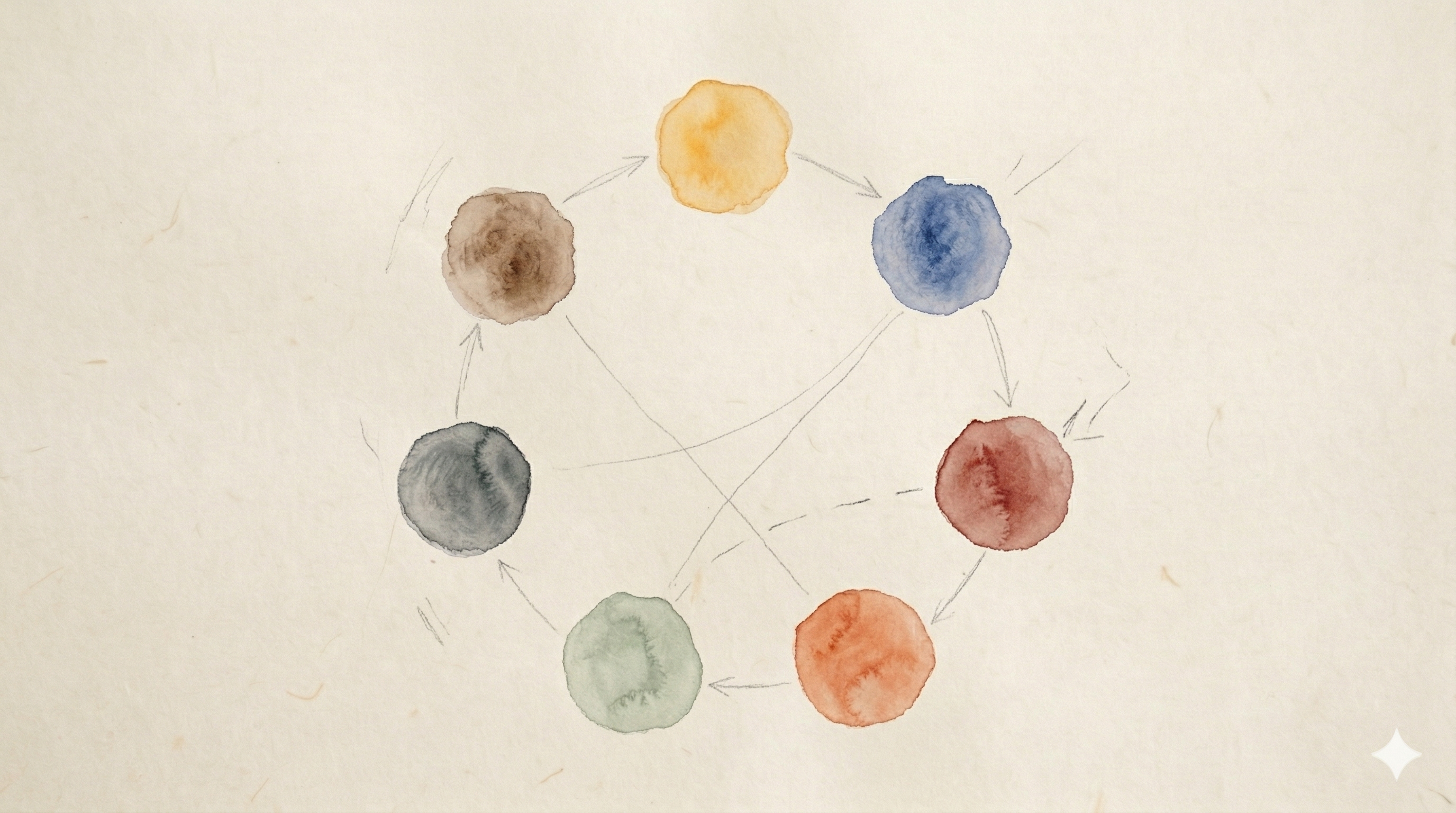
What did not fit
The essay argued that reality is a practice you maintain. I believe the argument. I am not sure I believe my own practice.
These are the places the piece wobbled for me in the weeks after I finished it. Not corrections. Admissions.
The Nyaya date
Last week I cited a date in a draft — the year the Nyaya Sutras were composed. I did not check it. I had pulled the date from an AI-generated summary during my research. It felt right. I was on a deadline.
I caught the error two days later. Off by a century.
A small mistake. Not catastrophic. What troubled me was how easily I accepted it. How fluency substituted for the verification I used to do automatically. I read the essay’s draft to a friend and she flinched, not at the date — she didn’t know it was wrong either — but at how confident the sentence sounded. That confidence was the tell.
The Quiet One in the essay asked: what if we stop caring whether something is true not because we can’t tell, but because it’s easier? I read that question in the draft. Then I caught myself being the answer.
The thread I bookmarked
Yesterday I read a thread summarizing a research paper. Fluent, confident, well-structured. I bookmarked it. I did not read the paper.
I accepted the summary the way you accept a photograph of a place you have never visited: as a reasonable substitute for the thing.
The guru’s maya keeps surfacing here. Not illusion, but functional construction mistaken for unmediated reality. The summary was a construction. I inhabited it as though it were the thing itself. Not because I am lazy. Because the construction was good enough, and good enough is where truth goes to die quietly.
I have not gone back to read the paper. I probably will not. That is the uncomfortable part.
The circularity
Every fact in the Reality Question was checked by me. Some of those checks involved asking a language model to verify claims about language models. The circularity is not lost on me. It is the condition.
I am writing about how AI erodes truth using the same AI systems I am arguing erode it. The mirror writes about the mirror using the mirror. There is no outside to step to. The Marginalia in the essay names this — what I left out is that I notice the circularity most when the verification comes back too cleanly. When the model confirms what I already believed in the exact register I believe it in. That is when I should be most suspicious. That is when I am usually most relieved.
The self-trust layer is not something I observe from a safe distance. I am standing on it. I can feel it give.
A stack — I am not sure yet
One thing I keep returning to but could not structure into the main essay: truth does not feel like a thing that can break. It feels like a stack.
Sensory trust. What I see with my own eyes. Deepfakes crack this from below.
Institutional trust. What the newspaper, the court, the journal tells me. AI floods this faster than any editorial board can verify.
Social trust. What the people around me believe. Bots manufacture consensus where none exists.
Narrative trust. The stories that make the world feel coherent. AI generates perfect stories around false premises.
Self-trust. What I think I chose. Algorithms reshape this so quietly that I cannot tell what is mine anymore.
I do not know yet if this is a real framework or a metaphor that helps me get through Tuesday. I have not found it argued anywhere. I suspect I will write this essay one day, after the series closes, when I can see what the other questions reveal about it. For now it sits in the margin of an essay about reality because the essay did not have room for it, and because naming a thing as uncertain is closer to honest than naming it as a framework.
What bothers me most is not any single layer cracking. It is the sense that when each one fails, people lean on the next — until there is nowhere left to fall.
The question I am sitting with
Reality, the essay argued, is a practice. Not a state you discover. A practice you maintain.
I want that to be true. I am less sure I am maintaining it.
The practice requires paying the cost of verification when the cost is unreasonable. Especially when the cost is unreasonable. That is not a difficulty I can outsource. It is not a habit that compounds quietly in the background while I do my actual job. It is the job.
And here is the question I am sitting with this week. What do you do when you notice the practice is slipping in yourself? Not in the culture, not in the discourse, not in the next person. In you. On a Tuesday. With a deadline. With a date that feels right.
I do not have an answer. I have a suspicion.
The practice of checking does not fix the ecosystem. It may not even fix the individual claim. But it changes the person doing the checking. Every time I trace one link further than convenience allows, something small inside me re-sets. Not the world. Me. The cost of verification, paid in private, is not wasted just because no one sees it. It may be the only thing keeping me from becoming the Quiet One’s answer.
That may be all pramana was ever meant to do.
These notes are a working copy. I will add to them as the thinking grows.
The Big Questions of AI
Seven questions. One clearing that may not be what it seems.
Prologue: The Big Questions of AI
1 · Intelligence · notes · essay · Five Fractures
2 · Consciousness · notes · essay · The Mirror Test
3 · Reality · notes · essay · The Trust Stack ◄
4 · Purpose · notes · essay · Five Conversations
5 · Freedom · notes · essay · The Cage Inventory
6 · Power · notes · essay · Five Maps
7 · Evolution · notes · essay · Five Endings
Epilogue: The Clearing Was a Room