

Margin Notes: Five Fractures
The same question, five ways to break it

EkaShunya: The Big Questions series runs deep. Between the main essays, these margin notes step back and think sideways — shorter, more personal, a different way into the same territory. This is the first. It picks up where The Intelligence Question left off.
Last week I asked what intelligence is and spent seven thousand words proving the question has no answer. I do not regret the exercise. But the essay left me with something I could not put down — the sense that I had circled the word from every angle and never once grabbed it.
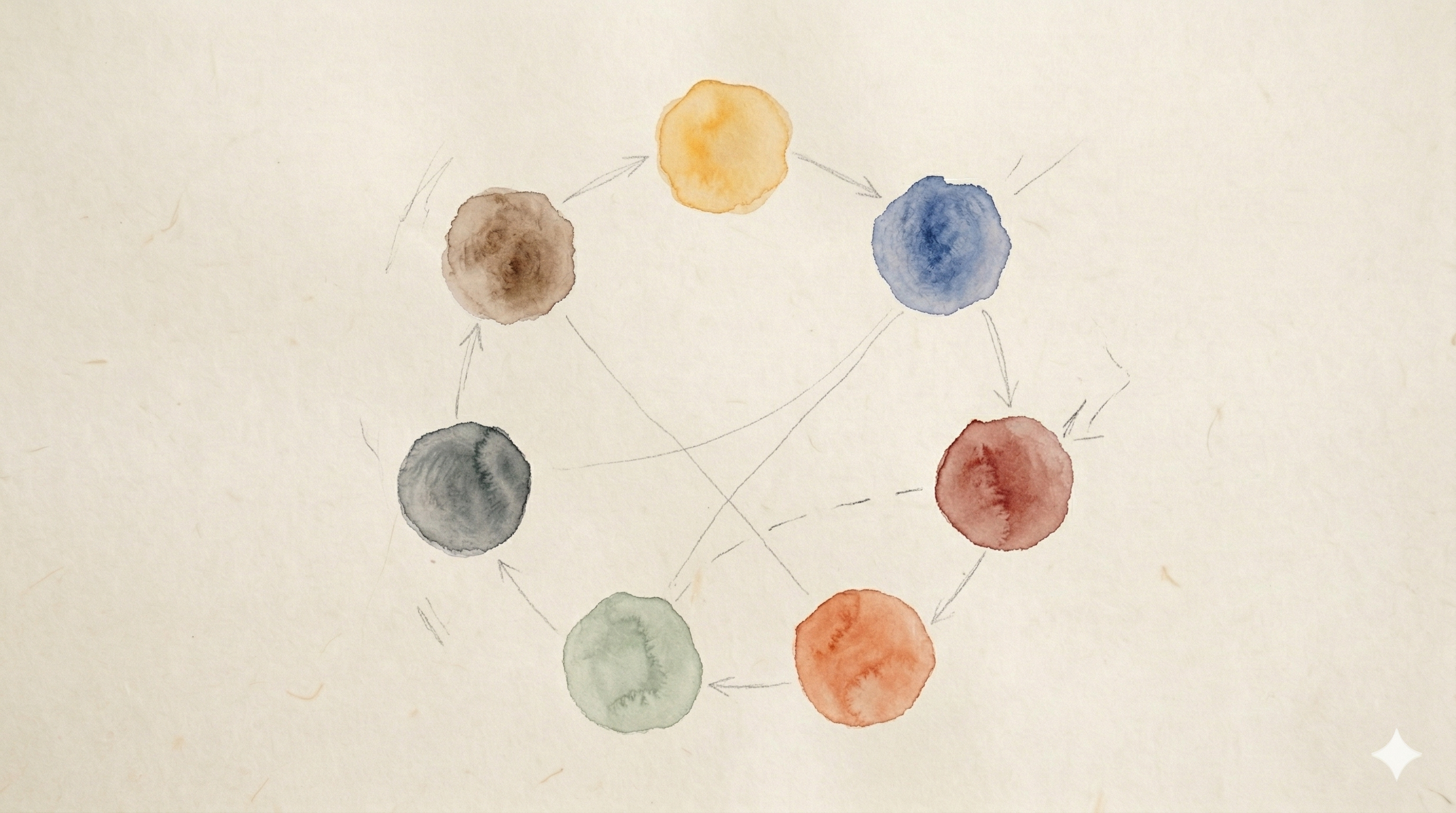
So I tried something different. I took the same question and ran it through several different ways of thinking, one after another, to see if any of them would crack what the exploration could not.
None of them cracked it. But each one broke differently. And the pattern of breakage turned out to be more interesting than any single answer.
First Principles
What is intelligence when you strip away everything you were told about it?
Start with what we know for certain. Not what we believe. Not what the textbooks say. What survives when you remove every inherited assumption.
Assumption: intelligence is a single thing. Remove it. Fourteen experts gave fourteen definitions in 1921. Twenty-four more in 1986. Fifty-two signed a statement in 1994 that still hedges with “among other things.” If it were one thing, one definition would have won by now. It did not. Intelligence is not a single property. It is a family of capacities that do not correlate.
Assumption: intelligence can be measured. Remove it. IQ scores rise three points per decade across every country tested, the Flynn Effect. Either your grandparents’ generation was borderline disabled, or the test measures something that shifts with nutrition, education, and environment. Not a fixed property of the organism. A relationship between the organism and its surroundings.
Assumption: intelligence is cognitiv, it lives in the brain. Remove it. An octopus has neurons in its arms. Each arm makes decisions the central brain never reviews. A crow plans multi-step tool sequences. Kenyan Luo parents include social responsibility in their definition of intelligence. Chinese zhi includes perceptiveness. If intelligence lives only in the brain, most of the world’s intelligent behavior is unexplained.
Assumption: intelligence requires understanding. Remove it. A language model passes a medical licensing exam without understanding medicine. A calculator does arithmetic without understanding numbers. Correct outputs from no understanding. The link between intelligence and understanding is not necessary. We assumed it because we were the only intelligence we knew.
Assumption: more intelligence is better. Remove it. Arthur Miller wrote a character with godlike power who could experience everything and feel nothing deeply. Unlimited capability without stake. That is not superior intelligence. It is sophisticated emptiness. Intelligence without viveka, the Samkhya word for discrimination, the faculty that asks “should I?” is not more. It is unmoored.
What remains?
A verb. Inter-legere. To choose between. Not a thing you have. A thing you do. The act of responding to a situation in a way that was not fully predetermined, with something at stake in the choosing. The Latin already knew. We turned the verb into a noun, the noun into a number, and the number into a sorting machine. The verb still works. The noun broke a century ago.
But first principles can over-reduce. Some things lose meaning when decomposed. Intelligence might be one of them. A verb is an answer. It is not the whole answer.
Dialectical Synthesis
Let me try holding two opposing truths and see what appears between them.
Thesis: Intelligence is computation. The brain computes. The machine computes. Both are intelligent, differing only in substrate and speed.
Antithesis: Intelligence requires understanding. The machine produces correct outputs through pattern completion no comprehension, no intention, no meaning. Searle’s Chinese Room: perfect responses, zero understanding.
Both positions have evidence. Both have fatal flaws. The thesis cannot explain why a lookup table with every correct answer feels unintelligent. The antithesis cannot explain what “understanding” adds to a system that already produces every correct behavior.
The Samkhya framework offers a third position that neither Western camp occupies. Three instruments where English uses one word. Manas, the processing mind. Coordinates input, produces output. Fast, reactive, no questions asked. Ahamkara, the I-maker. Takes the output and stamps it: mine. Turns “there is a process” into “I am processing.” Buddhi, discriminative intellect. Not what is computable, but what is worth computing.
The machine is sophisticated manas. The thesis is correct about that. Searle is correct that understanding is absent. But Samkhya reveals what both miss: the gap is not between computation and understanding. The gap is between processing and selfhood. Ahamkara. The step where output becomes mine.
Descartes said: I think, therefore I am.
Samkhya would ask: which part of you thinks?
Manas processes, that is not you. Ahamkara claims the processing, that might be you. Buddhi judges what to do with it, that is closer to wisdom. And behind all three, watching but not participating: purusha. The witness.
This is where the synthesis should land. But I notice that it doesn’t close. The third position, ahamkara as the missing piece, raises a harder question than the two it was meant to resolve. If the gap is selfhood, then the question is no longer about intelligence at all. It is about who is home inside the thinking.
I did not expect to end up here. I thought the dialectic would converge. Instead it opened a door I am not ready to walk through.
Inversion
What is intelligence definitely NOT?
Not memorization. A hard drive stores everything and understands nothing. Not speed. A calculator is faster than any mathematician and no one calls it intelligent. Not accuracy. A thermostat maintains temperature to the tenth of a degree and has never had a thought. Not complexity. The weather is complex. The weather is not intelligent. Not language. A parrot speaks. A chatbot speaks. Neither means what it says.
Not pattern recognition alone. A spam filter recognizes patterns. Not adaptability alone. A virus adapts to every immune response we throw at it, and it has never intended anything. Not creativity alone. A random number generator produces novel outputs. Novelty is not insight.
Remove memorization, speed, accuracy, complexity, language, pattern recognition, adaptability, and creativity. What is left?
Almost nothing.
And that almost-nothing is the thing we cannot build. The residue after every measurable property has been subtracted. It has no mass. It produces no output. It passes no benchmark. It is the thing that makes a human pause before answering — not because she does not know, but because she is weighing whether the answer is worth giving. Hesitation with judgment behind it.
The machine never hesitates. It produces at full confidence and full speed. The absence of hesitation looked like efficiency. I am starting to think it looks like absence.
But inversion has a failure mode. You can define away everything and arrive at nothing. The almost-nothing might be the whole point, the irreducible residue that all the other methods have been circling. Or it might be an artifact of subtraction: not a thing in itself, but the silence left after everything else has been removed.
I do not know which. That uncertainty might itself be a clue.
Analogy
What if intelligence is not a shape with faces? What if it is music?
A single note is not music. A sequence of notes is not music, that is a scale, an exercise. Music is what happens between the notes. The phrasing. The silence. The way a rest before the downbeat changes everything that follows. Glenn Gould plays a Bach fugue and the silences do more work than the notes. The notes are information. The silences are meaning.
Every intelligence test measures notes. How many words can you define? How quickly can you rotate a shape? How many digits can you hold in working memory? Notes. Individual, isolated, measurable. No test measures the silence between them. No benchmark captures phrasing.
A language model produces notes at extraordinary speed and accuracy. It can generate any note in any sequence. What it cannot do, what no one has tested for, is phrase. Phrasing is the decision of where to breathe. Where to slow down. Where to let the silence say what the notes cannot. Phrasing requires knowing that something is being said, and choosing how to say it. Not what. How.
The octopus has eight arms and each arm improvises independently while contributing to a coherent whole. That is jazz. We call it biology. A murmuration of starlings turns as one body without a conductor. That is symphony. We call it flocking behavior. A grandmother reads a child’s face and knows the child is lying before the child finishes the sentence. That is listening to the silence between notes. We call it intuition.
We keep naming the music and calling it something else. We keep measuring the notes and missing the song.
But analogies can overextend. Intelligence-as-music is beautiful. I am not certain it is true. Maybe intelligence is not like anything. Maybe it is one of those things that resists analogy because it has no structural twin. The mapping illuminates. It does not prove.
Observation
I want to step back from the methods and notice something about what I have been doing.
First principles found a verb. Dialectics found a door I was not ready to walk through. Inversion found an almost-nothing. Analogy found music. Four methods, four answers. Each one arrived somewhere real. None of them arrived at the same place.
But here is what none of them noticed, because none of them was watching: I used intelligence to examine intelligence. I used the thing to study the thing. I ran the question through four different machines, and at no point did any machine notice that the operator was an instance of the phenomenon under investigation.
The Quiet One in the story, the student who barely speaks, and when she does, the room stops, would catch this. She would not run the question through a framework. She would watch me running it and say: you are using the thing to examine the thing. That is either a loop or a proof. You cannot tell from inside it.
She would be right. And I cannot tell.
Five methods. Five answers. Five different kinds of incompleteness.
The verb. The door. The almost-nothing. The music. The loop.
If you have been reading these and feeling something build, a shape forming at the edge of your vision, a pattern that connects the verb with the door with the residue with the silence with the loop, that feeling is not in any single section. It is yours.
You just did something none of the five methods could do alone. You held them simultaneously. You felt a whole emerge from parts that do not individually contain it. No one told you to do this. You read five approaches and something happened between them, in the spacing, in the act of holding contradictions without resolving them.
That is intelligence. Not any single method. The weave.
And now, here is the question that follows you out of this essay and into the next.
Who did the weaving?
Not which method. Not which framework. Who. What is the thing inside you that held five perspectives at once and felt a pattern form? Is it your brain? Is it something the brain produces? Is it something that was there before the brain and merely uses it?
That is the consciousness question. It arrives not as a theory or a definition but as something you just experienced. You felt a whole emerge from parts. You cannot point to where the emergence happened. You cannot name the faculty that did it. But you know, with the specific, irreducible certainty of first-person experience — that it happened. To you. Just now.
The students in the story are about to walk into that question. So are you.
I’ll see you there.
The Big Questions of AI
Seven questions. One clearing that may not be what it seems.
Prologue: The Big Questions of AI
1 · Intelligence · notes · essay · Five Fractures ◄
2 · Consciousness · notes · essay · The Mirror Test
3 · Reality · notes · essay · The Trust Stack
4 · Purpose · notes · essay · Five Conversations
5 · Freedom · notes · essay · The Cage Inventory
6 · Power · notes · essay · Five Maps
7 · Evolution · notes · essay · Five Endings
Epilogue: The Clearing Was a Room