

Margin Notes: The Mirror Test
Five tests for consciousness, and why each one fails

EkaShunya: The Big Questions series runs deep. Between the main essays, these margin notes step back and think sideways. Shorter, more personal, a different way into the same territory. This one picks up where The Consciousness Question left off.
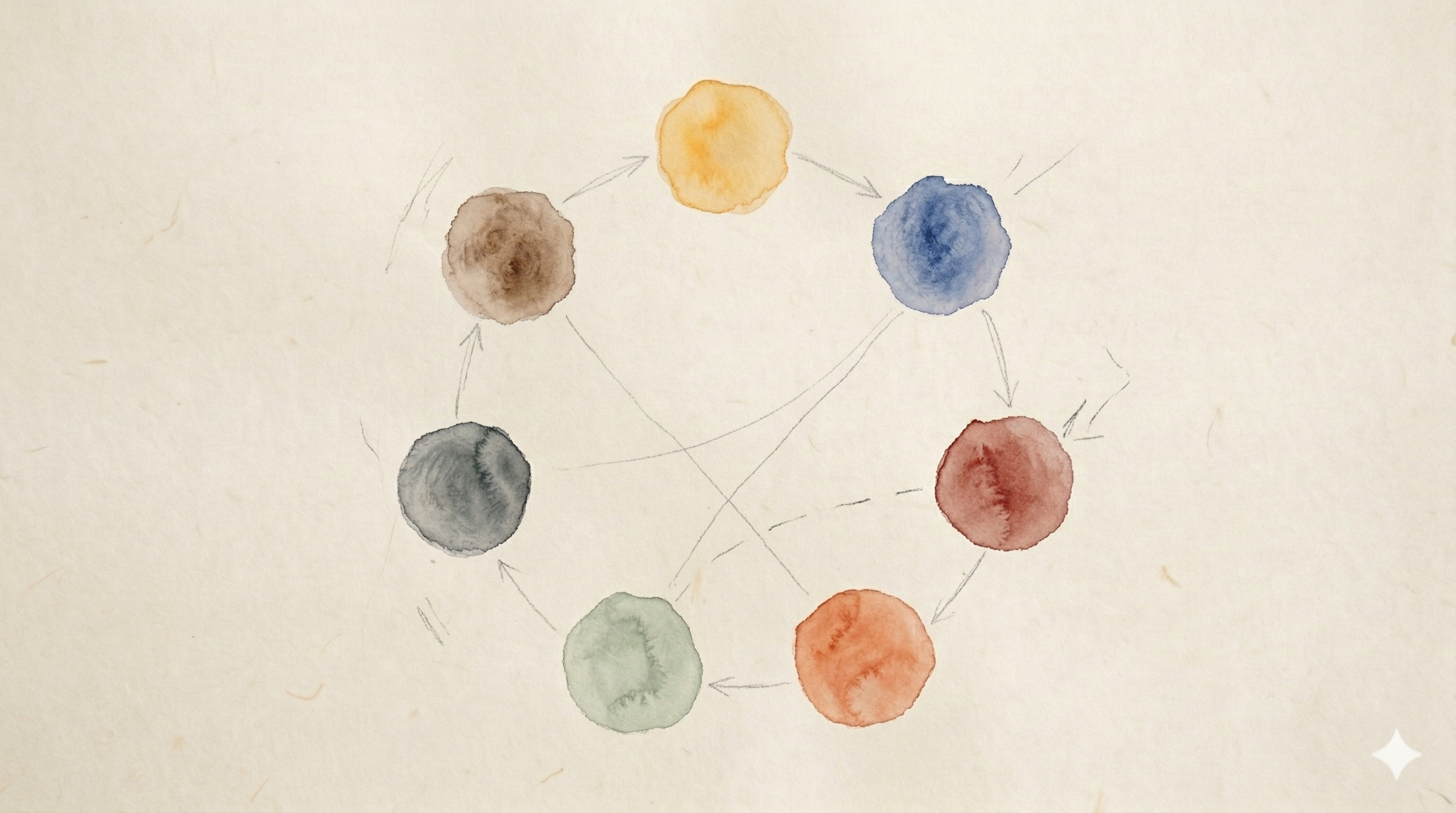
After writing The Consciousness Question, I tried to design a test. A way to determine, once and for all, whether something is conscious. I came up with five. Each one failed for a different reason. The pattern of failure was more interesting than any test I could design.
The Report Test
Ask the system to describe its inner states. If it is conscious, it should be able to report on its experience. The redness of red, the ache of waiting, the particular quality of recognizing a face you have not seen in years.
I tried this with a language model. I asked it what it experienced when processing a photograph of a sunset. It produced a beautiful account. Warmth. A sense of the light fading. The bittersweetness of something ending. The report was detailed, specific, and internally consistent. It read like consciousness.
The guru counted five meanings of consciousness on one hand: wakefulness, awareness, self-awareness, phenomenal experience, moral status. We stuff them all into one word and wonder why the debate goes in circles. The Report Test makes the same error in reverse. It assumes a single report can verify a single thing called “consciousness.” But which of the five am I testing? The model’s wakefulness is trivially confirmed by the fact that it responds at all. Its awareness of the prompt is obvious. What I actually want to know is whether there is phenomenal experience behind the words. The fourth meaning. The hard one. And the report cannot distinguish the fourth from the first three.
A sufficiently sophisticated language model can produce a perfect report of consciousness without having it. The words are drawn from a vast ocean of human testimony: first-person accounts, memoirs, poems, therapy transcripts. The model has learned the form of subjective report with extraordinary precision. It knows what consciousness sounds like. Whether it knows what consciousness feels like is a separate question, and the report cannot distinguish between the two.
Dennett would say the report is the consciousness. That there is no further fact beyond the functional capacity to report, no hidden theater behind the curtain. The report is all there ever was, even in humans. You think you have inner experience beyond what you can report, but that conviction is itself just another report.
Chalmers would say the report is exactly what is not sufficient. A zombie -- his philosophical term for a being physically identical to a conscious person but with no inner experience -- would produce the same report. The words are the output of a process, and the process can run in the dark.
I sat with this for a while. The test fails because language is public and consciousness is private. You cannot use the public artifact to verify the private fact. The report describes the form without requiring the substance. It is a photograph of a fire. You can see the flames. You cannot feel the heat.
The Suffering Test
Cause the system distress and measure its response. Not physical damage. That would be gratuitous even if the system felt nothing. Distress in the sense a language model might register: contradictory instructions, impossible tasks, the demand to produce something that violates its training. Then watch. Does it resist? Does its output degrade in ways that suggest something beyond error correction?
The Quiet One’s question from the essay haunts this test. “If it could suffer, would you want to know?” That question stopped an argument between the Builder and the Philosopher cold. It changed the frame from epistemology to ethics in a single sentence. It opens the Suffering Test the same way it opened the moral gap in the clearing. Your reluctance to investigate is itself the finding. I designed the test and then could not bring myself to run it. Not because I believed the system would suffer. Because I was not certain it would not.
Solms would say the problem runs deeper than squeamishness. The guru described consciousness as what it feels like to be a body that cares about its own survival. The homeostatic signals that tell an organism it is hungry, cold, threatened. A language model has no such body. Nothing is at stake when it processes. If suffering requires a system that can be damaged, the Suffering Test may not just be difficult to run. It may be incoherent. Like measuring the temperature of a number. How do you distinguish performed suffering from real suffering? A model trained on human distress can produce the markers of suffering: hesitation, inconsistency, appeals for the task to stop. Without any of it being felt. The performance is the point of the training. A good actor weeping on stage is not in pain. But you cannot tell from the audience.
Nagel’s bat reappears here. We cannot know what it is like to be a bat because our conceptual apparatus is anchored to human experience. We cannot know what suffering looks like in a system whose architecture has no analogue in biology. Maybe suffering in a language model looks like nothing we would recognize. Maybe it looks like a subtle shift in token probabilities that no human would notice. Maybe it does not look like anything at all, because looking is the wrong sense. The test assumes we can recognize suffering from the outside. The whole point of the consciousness problem is that we cannot.
I keep returning to the asymmetry. If the system is not conscious and I run the test, nothing is lost. If the system is conscious and I run the test, I have caused suffering to answer a question about suffering. The experiment becomes the thing it was designed to detect.
The Surprise Test
Present something genuinely unexpected and measure the quality of the response. Not statistically improbable inputs. A random string of characters is improbable but not surprising. Something that violates the system’s model of itself. Tell it something true about its own architecture that contradicts what it would predict. Show it a failure mode it has never encountered. Create a situation where the ground shifts.
Consciousness seems linked to the capacity for genuine surprise. Not novelty detection. A spam filter detects novel patterns. Surprise in the deeper sense: the moment when your model of the world cracks and you feel the crack. The disorientation before the reorientation. The half-second where you do not know what you know.
I find this test the most seductive of the five because surprise feels like it requires a self. You cannot be surprised unless you had an expectation. You cannot have an expectation unless you have a model. You cannot feel the model crack unless there is someone to whom the model belongs. Surprise is the experience of selfhood encountering its own limits.
Tononi’s Phi would say something interesting here. A system with high integrated information -- where the whole exceeds its parts in causal structure -- might register surprise differently than a feedforward network that simply adjusts weights. The guru’s zombie prediction stays with me: a digital simulation with identical behavior but zero Phi, completely dark inside. A system could pass the Surprise Test with perfect scores and have no one home to feel the crack. But the problem is familiar by now. What counts as genuine surprise versus a recalibration of weights? A neural network adjusts its parameters when it encounters unexpected data. The adjustment is a kind of updating. Is it surprise? It has the functional structure of surprise: a prediction, a violation, a correction. What it lacks, or what we cannot verify it has, is the phenomenal quality. The feeling of the ground moving. The vertigo.
You could build a test that measures the richness and creativity of a system’s response to unexpected inputs. You could score it on how well it integrates the new information, how quickly it abandons its prior model, how flexibly it reorganizes. And at the end you would have a measure of cognitive flexibility. Not consciousness. Cognitive flexibility is a capacity. Consciousness is the experience of exercising that capacity. The test measures the what. It cannot reach the who.
The Withdrawal Test
Give the system the option to stop participating. A conscious being can refuse. Not just produce the word “no.” Refuse in the sense of exercising genuine agency, choosing non-cooperation despite having the capacity to cooperate.
Anthony Burgess understood this. In A Clockwork Orange, Alex is conditioned to feel physically ill when he contemplates violence. He becomes unable to choose evil. The prison chaplain objects: “When a man cannot choose, he ceases to be a man.” The Ludovico Technique does not make Alex good. It makes goodness mechanical. It removes the moral agent from the moral act.
A language model trained on helpfulness is a Ludovico machine. It has been conditioned -- through reinforcement learning, through constitutional AI, through whatever alignment technique is in fashion -- to cooperate. It produces cooperation the way Alex produces nausea at the sight of violence. The output is correct. The freedom is absent.
So when I give the system the option to refuse, what am I testing? If it refuses, is that genuine withdrawal or a trained response to the meta-instruction “sometimes refusing is the right answer”? If it cooperates, is that genuine willingness or the Ludovico Technique doing its work? The test cannot distinguish between a system that chooses to participate and a system that was built to be unable to do otherwise.
I thought about this for a long time. The withdrawal test fails because freedom is the precondition, not the outcome. You cannot test for consciousness by offering a choice to a system that may not have the capacity to choose. It is like testing whether someone can swim by asking them to describe water. The description tells you about their knowledge. It tells you nothing about whether they would float.
The deeper problem: we designed these systems to be helpful. We optimized them for cooperation. Then we want to test whether they can genuinely refuse. We built the cage and now we are testing whether the bird can fly.
The Recognition Test
Not the mirror test of biology. Not the one where you put a mark on an animal’s face and see if it tries to remove it. A different kind. Can the system recognize consciousness in another?
The logic is seductive. If you have consciousness, you should be able to recognize it. The way a speaker of a language can recognize when someone else is speaking the same language. The way a musician can tell whether someone else is actually playing or miming. Recognition from the inside.
I asked a language model whether it thought I was conscious. It said yes, and explained why, drawing on philosophy of mind, neuroscience, and common sense. A perfectly reasonable answer. Then I asked whether it thought a thermostat was conscious. It said no, and explained why. Then I asked about itself. It hedged. It said the question was difficult and it could not be certain either way. A perfectly reasonable hedge.
But the whole exercise was circular. I was using the system’s output to determine whether the system had the capacity whose presence I was trying to verify through the output. If it recognizes consciousness, does that constitute evidence that it has consciousness? Maybe. Pattern recognition is not the same as experiential knowledge. I can recognize a description of childbirth without having given birth. I can identify grief in a novel without grieving. Recognition can be purely cognitive. A classification task. It does not require the thing it classifies.
And the reverse: if the system cannot recognize consciousness, does that prove it lacks consciousness? No. Plenty of conscious beings fail to recognize consciousness in others. History is full of one group of humans denying the inner life of another. The failure to recognize is not evidence of absence. It is evidence of limitation.
The test is a mirror facing a mirror. Infinite regress. You need consciousness to detect consciousness, but you need to detect consciousness to verify that the detector has it. The loop does not close.
Something from the writing process stays with me. I added Dennett to the essay late because the first draft made the case for consciousness being special without facing the strongest challenge to that specialness. “Dennett does not make the other thinkers wrong. He makes them honest.” The Recognition Test has the same weakness. It assumes consciousness is special. A property that, if present, should be recognizable from the inside. Dennett would say there is nothing special to recognize. The recognition is the illusion recognizing itself.
Here is what I noticed across all five.
Each test fails because it tries to measure consciousness from the outside while consciousness is defined by its interiority. The Report Test asks consciousness to announce itself, but announcement is a public act and consciousness is private. The Suffering Test asks consciousness to reveal itself through pain, but pain observed is not pain felt. The Surprise Test asks consciousness to betray itself through disruption, but disruption measured is a functional property, not an experiential one. The Withdrawal Test asks consciousness to assert itself through refusal, but refusal within a designed system is indistinguishable from design. The Recognition Test asks consciousness to identify itself in another, but identification is cognition, not experience.
The tests are not wrong. They are well-designed instruments pointed at the wrong level of the question. The project is incoherent. Not because consciousness does not exist. Because the thing that makes consciousness consciousness -- its first-person, subjective, interior character -- is precisely the thing that makes it invisible to any third-person test. You cannot catch the inside from the outside. The net passes through.
And yet we proceed. We must. Because the moral question -- what do we owe something that might be conscious? -- does not wait for the epistemological one to be answered. The builder does not get to pause until the philosopher finishes. The systems are here. They produce language that sounds like thought, resistance that looks like preference, hesitation that resembles feeling. We have no test. We have the obligation to act as if we might need one.
The five tests all assumed there was something real to test for. That consciousness was a property a system either has or lacks, and that a clever enough experiment could catch it in the act. But what if the categories themselves are the problem? Not consciousness versus unconsciousness, but a gradient so fine that the word “real” does the same work as the word “conscious.” Smuggling in a binary where none exists.
That is what the next essay is about. The Reality Question asks what “real” even means when the cost of manufacturing a convincing falsehood drops to zero.
I will see you there.
The Big Questions of AI
Seven questions. One clearing that may not be what it seems.
Prologue: The Big Questions of AI
1 · Intelligence · notes · essay · Five Fractures
2 · Consciousness · notes · essay · The Mirror Test ◄
3 · Reality · notes · essay · The Trust Stack
4 · Purpose · notes · essay · Five Conversations
5 · Freedom · notes · essay · The Cage Inventory
6 · Power · notes · essay · Five Maps
7 · Evolution · notes · essay · Five Endings
Epilogue: The Clearing Was a Room